
The 1958 half dollar value starts with grade, not with the date alone. This is not a key-date Franklin half. It is a coin where the market separates average pieces from better ones very quickly. Small grading differences can create a much larger value gap than many buyers expect.
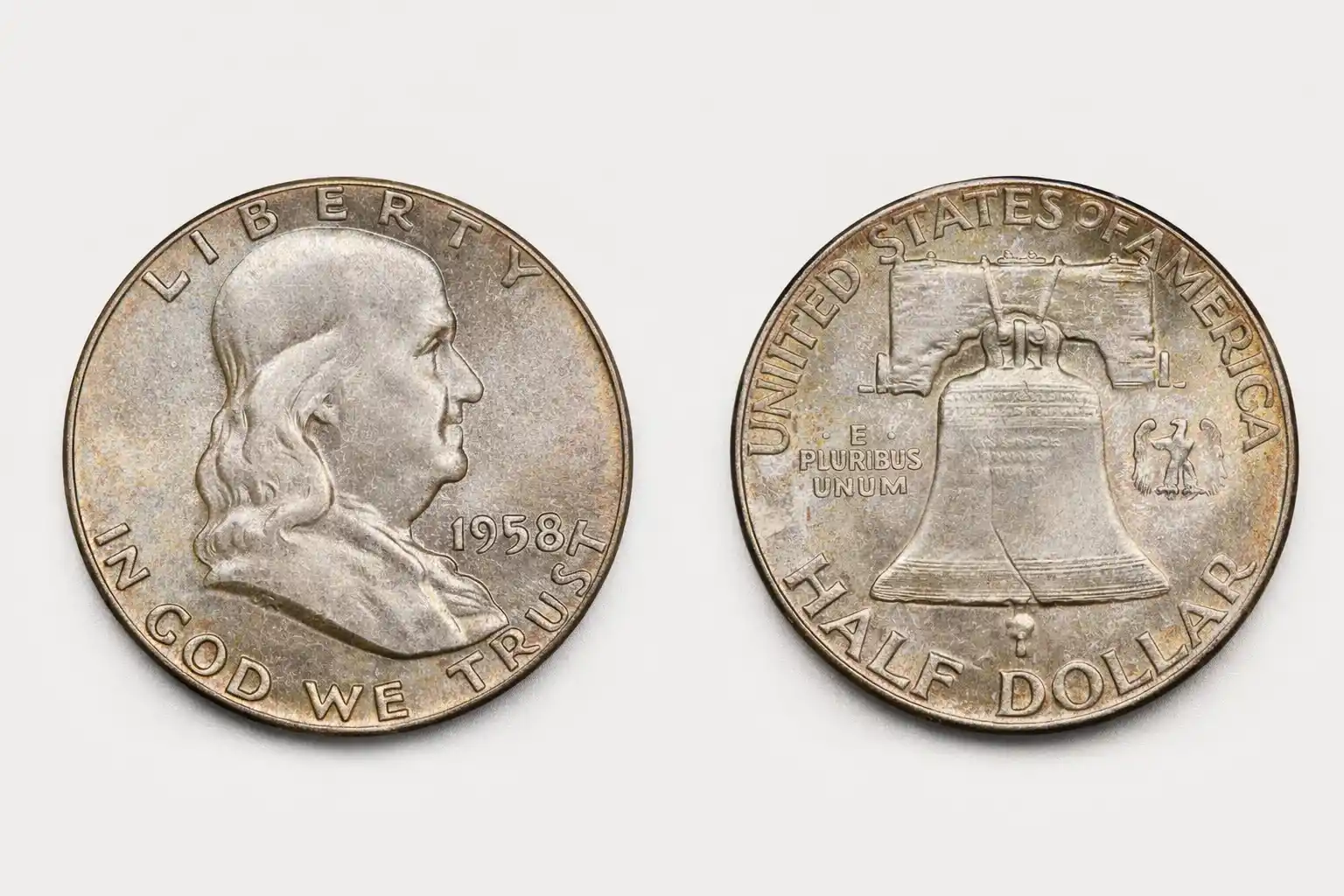
What Was Issued in 1958
The 1958 Franklin half dollar was struck for circulation at Philadelphia and Denver. A proof version was also made at Philadelphia. All of them were 90% silver, 10% copper, weighed 12.50 grams, and measured 30.00 millimeters. The 1958-P business strike at 4,042,000 pieces, the 1958-D at 23,962,412, and the 1958 proof at 875,652.
Issue
Mint mark
Type
Main grading focus
1958
None
Business strike
Wear, luster, marks, bell lines
1958-D
D
Business strike
Strike, luster, marks, bell lines
1958 Proof
None
Proof
Mirrors, hairlines, contrast
That matters because the market does not read all three in the same way. Business strikes are judged through wear, surface quality, strike, and Full Bell Lines. Proofs follow a different path. They rise or fall on mirrors, contrast, haze, and hairlines.
Why Grade Matters More Than the Date
A common date can still become an expensive coin. That happens when grade pushes it into a different market tier. With a 1958 half dollar, the date gets you into the room. The grade decides where the coin sits once you are there.
This is the basic structure:
Date is common
Surface quality separates coins
Strike quality changes demand
Bell lines add a second filter
Higher Mint State becomes a different market
That is why a raw 1958 half dollar should never be judged by year first. A buyer who starts with the date will miss the real driver. A buyer who starts with preservation will read the coin more accurately.
Start With Wear
Before thinking about Mint State, a collector should learn where wear appears first. Franklin halves make this easier than some other series. The high points are visible. When the coin circulates, those areas lose texture first, and luster breaks there early.
On the obverse, check Franklin’s cheek, hair above the ear, and shoulder line. On the reverse, check the bell, the lettering, and the open areas around the design. A circulated coin can still look decent, but once those spots flatten and the mint frost disappears, the value ceiling drops.
A practical split looks like this:
Lower circulated coins show clear smoothing
Better circulated coins keep more inner detail
About Uncirculated coins may keep much of the luster
Mint State coins should show no wear on the high points
That last line matters. A weak strike can imitate wear. A soft bell or muted hair detail does not always mean the coin circulated. This is one of the main grading traps in the series.
Mint State Is Not One Level
Many new buyers treat Mint State as one broad category. The market does not. A 1958 half dollar in MS63 and one in MS65 are both uncirculated, but they do not look the same and do not sell the same. The jump is built from small differences: fewer marks, stronger luster, cleaner fields, and better overall balance.
Grade range
General look
Market impression
MS63
Decent but busy
Entry Mint State coin
MS64
Cleaner overall
Better collector coin
MS65
Stronger luster, fewer distractions
Premium zone
MS66 And higher
Scarcer quality
Advanced buyer tier
This is where the article title becomes real. Value does not move because a grading label sounds nicer. It moves because the coin starts to look visibly different. An MS63 coin may still have many marks in the cheek and fields. An MS65 coin usually feels calmer. The surfaces are less interrupted. The luster carries better. The whole coin looks more controlled.
The Four Details That Move the Grade Most
Luster
Luster is the first broad signal of freshness. A better 1958 half dollar should look alive under light. Not flashy in an artificial way. Just active and original. If the surface looks dull, washed out, or flat, the coin usually stops below the better Mint State levels.
Contact marks
Franklin halves are large enough to show marks clearly. The cheek is important. The fields matter, too. A coin can keep good luster and still lose grade because the open areas are too busy. This is why “nice for the grade” and “high grade” are not always the same thing.
Strike
Strike quality matters more than many beginners think. A softly struck coin may look weaker even without wear. The reverse often tells the story. If the bell lacks crisp lines, the coin may still be Mint State, but it may not move into the premium part of the market.
Eye appeal
This is the summary effect. It is not a vague extra. It is the way luster, marks, strike, and color work together. A technically decent coin can still feel average. A better coin looks balanced at a glance before the close study even begins.
Bell Lines Change the Whole Conversation
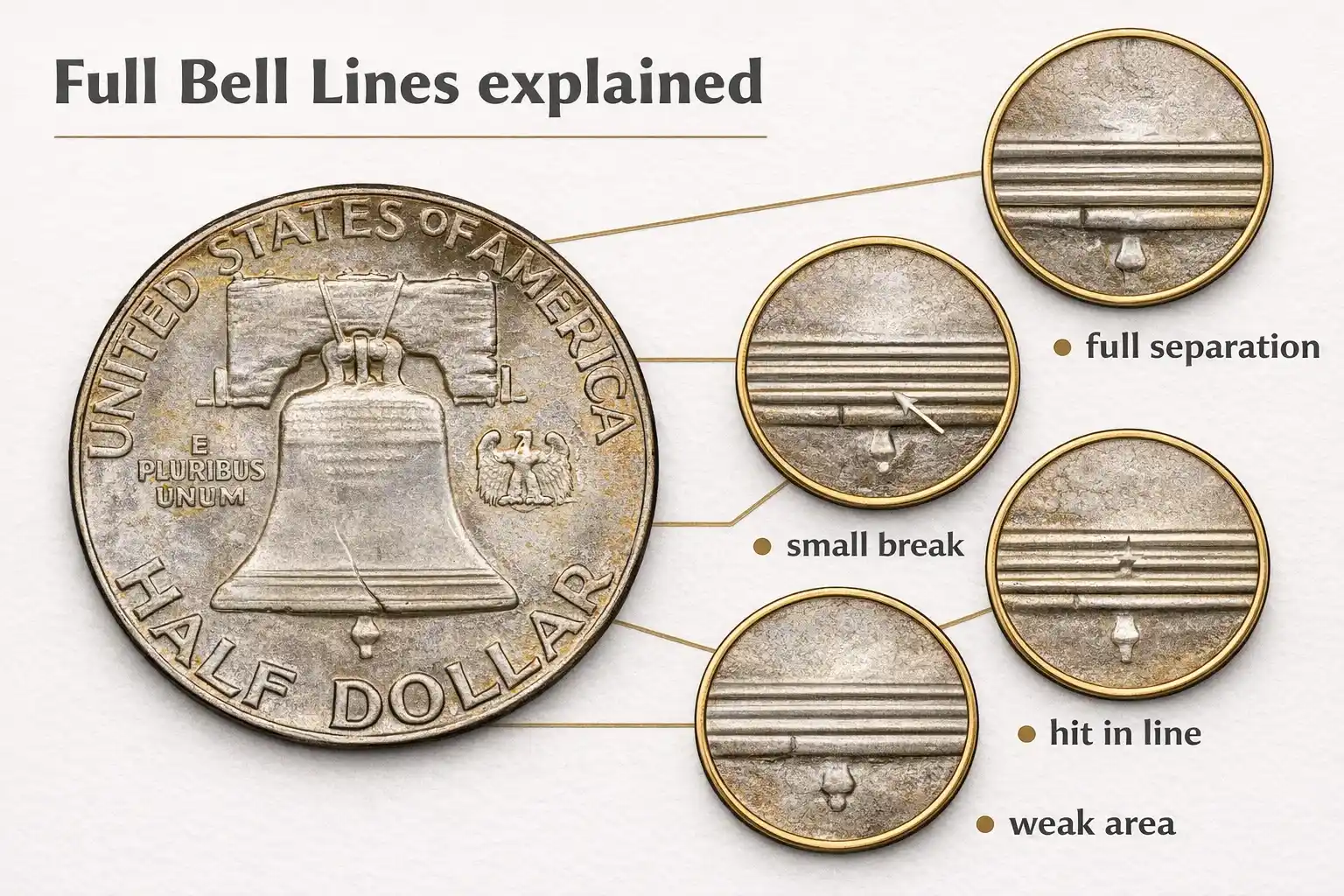
Full Bell Lines are not just another minor detail. On Franklin halves, they often create the sharpest value split. PCGS gives the designation to Franklin halves grading MS60 or higher when the lower lines of the Liberty Bell show full separation and no major cuts or marks interrupt them. NGC uses a similar standard and notes that a weak strike often leaves the lower bell lines incomplete.
That matters because many 1958 halves are decent coins without being premium coins. Bell Lines can move a coin from one category to the next. The coin does not have to become rare in an absolute sense. It only has to become harder to find in that sharper state.
A buyer should not check Bell Lines in a hurry. The lower lines need careful viewing. One break, one hit, or one weak area can change the designation. That single grading nuance can change the price conversation more than the date itself.
Where Buyers Misread the Coin
This is where overpaying usually starts. Not with a fake number. With a wrong read.
Common mistakes include:
Weak strike mistaken for wear
Bright surface mistaken for originality
Busy fields ignored
Bell lines are checked too casually
Small grade jumps treated like small value jumps
That last point is important. On a common-date Franklin half, the difference between average and premium is often narrow in appearance but wide in price. A buyer who sees “uncirculated” and stops there misses the structure of the market.
Check Price Only After You Read the Grade
A search like a free coin value lookup can help once the grading work is already done. Used too early, it confuses. A price result means little if you do not know whether the coin is circulated, AU, MS63, MS65, or an FBL candidate.
The better approach is simple:
Check the overall balance
Look at the luster first
Study the cheek and fields
Inspect the bell lines closely
Decide the grade range
Then compare prices
That order protects the buyer from the most common mistake: using a broad price range for a coin that belongs in a narrower and lower category.
Proof Is a Different Conversation
The 1958 proof half dollar should not be graded with the same priorities as a business strike. PCGS describes it as one of the more common proof dates in the Franklin series and notes that pieces below PR68 are fairly common, while higher-end examples become scarcer.
That changes what the buyer looks for. Bell Lines are not the focus here. Mirrors, hairlines, haze, and cameo contrast are more important. A proof can be bright and still be average. A proof can be well preserved and still lose appeal if the mirrors are cloudy or the fields are lined.
FAQs About 1958 Half Dollar Grading
Is a 1958 half dollar rare?
Not by date alone. The Philadelphia business strike had a lower mintage than many later Franklin halves, but the series still offers enough material that grade becomes the real divider.
What changes the value most on a 1958 half dollar?
Wear, luster, contact marks, strike, and Bell Lines. Those are the main filters. The year gets attention. The grade decides the price.
Can a bright coin still grade lower than expected?
Yes. Brightness does not erase marks, soft strike, or altered surfaces. A coin can look flashy and still sit in a modest grade range.
How can I sort versions faster without mixing them up?
A search like a coin identifier app free makes sense when several Franklin halves need quick sorting. Coin ID Scanner offers smart filters to narrow similar issues, its AI assistant helps with basic issue details, and its collection management keeps pieces organized once you separate business strikes from proofs. That still does not replace grading by eye. You still need to inspect luster, marks, and bell lines yourself.
Should I buy a non-FBL coin if the price looks good?
Yes, if the coin is honest, attractive, and priced as a non-FBL piece. No, if the seller prices it like a stronger premium coin. A pleasing non-FBL example can still be a very solid purchase.
Conclusion
The 1958 Franklin half dollar does not build value from date alone. It builds value from grade. Wear matters first. Mint State quality matters next. Bell Lines can change the entire tier. That is the real grading logic of this coin.
Read the surfaces before the number. Read the bell before the price. On a 1958 half dollar, that is what changes the value most.
